My Course Is Being Pirated — What to Do in the Next 24 Hours
You just found your course on a Telegram group, a torrent site, or a shady download page. The panic is real. Here's your exact action plan — what to do first, what can wait, and what mistakes to avoid.
You just found your course — the one you spent months building — being given away for free. Maybe a student tipped you off. Maybe you Googled your course name and found it on a site you've never heard of. Or maybe you stumbled onto a Telegram group with 12,000 members sharing your entire curriculum as a zip file.
However you found out, this guide is your playbook for the next 24 hours. Not theory — specific actions in chronological order. By the end of today, you'll have takedown notices filed, evidence preserved, and a system in place so this doesn't blindside you again.
First: Don't Panic (But Don't Wait Either)
Piracy is not a death sentence for your business. Industry estimates suggest that over 40% of premium online courses end up on at least one unauthorized sharing platform within weeks of launch. It's widespread, and it's survivable.
That said, speed matters. Every hour your content stays live on a piracy site, more people download it. Pirate groups re-share links. Search engines index new pages. The longer you wait, the harder cleanup becomes.
The goal in the first 24 hours is damage containment, not perfection. You won't eliminate every copy today — but you can knock out the biggest distribution channels and cut off new discovery.
Hour 1: Collect Evidence
Before you file a single takedown, document everything. This is non-negotiable. Screenshots and URLs are your proof, and pirate pages get moved, renamed, and deleted constantly.
What to capture
- Full-page screenshots of every infringing page you find. Include the browser URL bar in the screenshot — this proves the URL and the content existed at that moment.
- The exact URLs— copy them into a spreadsheet or document. You'll need these for every takedown notice you file. Be precise: the full URL with path, not just the domain.
- Timestamps — note when you found each link. Some DMCA processes ask for this.
- Download links— if the pirate page links to a file host (Mega, MediaFire, Google Drive), capture that URL too. You'll need to file takedowns with both the listing site and the file host.
Use the Wayback Machine's "Save Page Now" feature at web.archive.org to create a timestamped snapshot of each pirate page. This creates independent, third-party evidence that the page existed — useful if you ever need to escalate legally.
What NOT to do
- Don't download the pirated contentto verify it's yours. You don't need to — and on some torrent sites, downloading could expose your IP address to the sharing network.
- Don't engage with the pirates directly. No angry comments in Telegram groups. No threatening messages. It tips them off and gives them time to move the content before you can file takedowns.
- Don't post about it on social media yet.You want your takedowns processed before the pirate operators know you're coming.
Hour 2–3: Assess the Full Damage
The link you found is almost certainly not the only one. Pirates distribute across multiple channels simultaneously. You need to search systematically.
Search checklist
- Google Search— search your exact course title in quotes. Then search it with terms like "free download", "torrent", "mega link", and "telegram". Check the first 3–5 pages of results.
- Bing — repeat the same searches. Bing often indexes pirate sites that Google has already delisted from previous DMCA requests.
- Yandex and DuckDuckGo — this is where most people stop and most anti-piracy services skip. Many pirate pages that are gone from Google still rank here. Yandex in particular has a large Russian and Eastern European user base where course piracy is common.
- Telegram— search for your course name, your brand name, and your own name in Telegram's search. Check both public channels and groups.
- Torrent sites — search your course title on major torrent indexes. If your course appears, note the specific torrent listing URL.
- Discord — search for your course name on Discord server listing sites. Private servers are harder to find, but public listings often expose them.
Add every URL you find to your evidence spreadsheet. Categorize them by type: search engine listing, sharing platform (Telegram, Discord), file host (Mega, MediaFire), or piracy website.
Hour 3–6: File Your First Takedowns
Now you have evidence and a list of infringing URLs. Time to send takedown notices. Start with the platforms that are most likely to respond quickly and have the biggest impact.
Priority order
- File hosts first — Mega, MediaFire, Google Drive, Dropbox. These hold the actual files. If the file disappears, every page linking to it becomes a dead end. Mega typically processes DMCA requests within hours. Google Drive uses a dedicated form at reportcontent.google.com.
- Piracy listing sites — the pages that list and link to the downloads. Most have a DMCA agent listed in their terms of service or footer. Send a formal DMCA notice to each one.
- Telegram — email your DMCA notice to dmca@telegram.org. Telegram does not have an online form — everything goes through email. Include direct links to the specific infringing messages or channels, not just channel names. Response times vary from a few days to two weeks.
- Discord— Discord has a dedicated DMCA form in their Trust & Safety reporting system. They're generally responsive within a few days.
What every takedown notice must include
Under Section 512(c)(3) of the Digital Millennium Copyright Act, every valid DMCA takedown notice must include six elements. Platforms can legally ignore notices that are missing any of them:
- Your physical or electronic signature (typing your full name counts for most platforms).
- Identification of the copyrighted work — a link to your original course page or sales page proving you created it.
- Specific URLs of the infringing material — exact page addresses, not homepages or domain names.
- Your contact information — name, address, phone number, email.
- A good-faith statement: "I have a good faith belief that use of the material in the manner complained of is not authorized by the copyright owner, its agent, or the law."
- A statement under penalty of perjury that the information in your notice is accurate and that you are the copyright owner or authorized to act on their behalf.
Every element matters. The most common reason takedowns get rejected is missing the perjury statement or providing vague URLs. Copy the exact statutory language — don't paraphrase it.
Hour 6–12: Request Search Engine Delisting
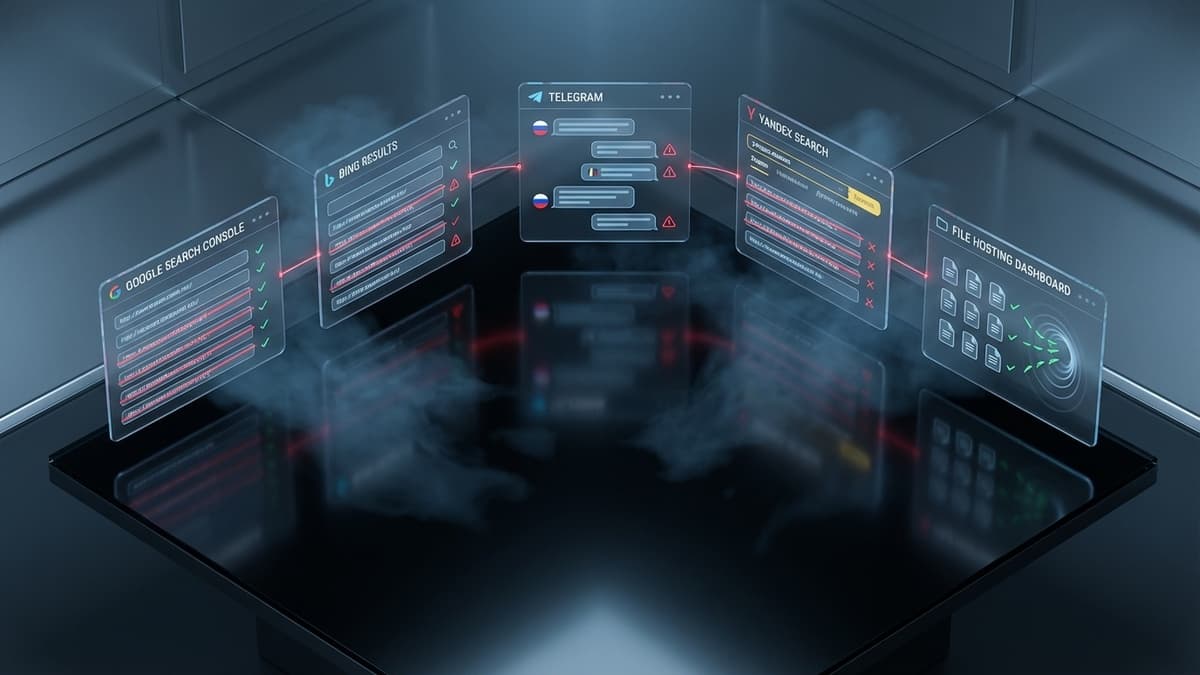
While your file-host and platform takedowns are processing, submit search engine delisting requests. This doesn't delete the pirated content, but it removes the discovery path— people can't find it by searching.
Submit through Google's DMCA reporting form at support.google.com/legal/troubleshooter/1114905. Select "Web Search" as the product, fill in your copyright details and the infringing URLs. Google typically processes straightforward requests within hours — many are handled the same day. After processing, Google forwards a copy of your notice to the Lumen database, a public transparency project maintained by Harvard's Berkman Klein Center.
Bing
Use Bing's content removal form (you'll need to sign in with a Microsoft account). The process is similar to Google's — provide your copyright claim, the infringing URLs, and sign the required statements. Bing provides a tracking dashboard where you can monitor the status of each request.
Yandex and DuckDuckGo
Don't skip these. Most creators — and most anti-piracy services — only file with Google and maybe Bing. Pirates know this. If your course shows up on Yandex or DuckDuckGo search results, the pirate links remain fully discoverable even after Google deindexes them. Each engine has its own submission process.
What to Do If You Get a Counter-Notice
Under the DMCA, the person whose content you took down has the right to file a counter-notice claiming the takedown was a mistake. When a platform receives a valid counter-notice, the law gives you a specific window to respond.
How the counter-notice timeline works
- The platform forwards the counter-notice to you (the original complainant).
- You have 10 to 14 business days to take action. This window comes directly from Section 512(g) of the DMCA.
- If you file a federal copyright lawsuit (or file with the Copyright Claims Board) and notify the platform within that window, the content stays down.
- If you do nothing within the 10–14 day window, the platform is required to restore the content. This is the most common outcome.
Counter-notices from pirates are relatively rare — most pirate operators don't want to provide their real name, address, and phone number (all required in a counter-notice) or consent to US federal court jurisdiction. But it does happen, especially with organized piracy operations.
If you receive a counter-notice, consult a lawyer before responding. The counter-notice process has real legal implications — the respondent is consenting to federal court jurisdiction, and your next move determines whether the content stays down or goes back up.
After the Fire: Preventing the Next Leak
You've filed your takedowns. Some have already been processed, others are in the queue. The immediate crisis is under control. Now set up systems so the next leak doesn't catch you off guard.
Ongoing monitoring
- Google Alerts— set up alerts for your course title, your name, and your brand name combined with terms like "free download", "torrent", and "telegram".
- Weekly manual checks — spend 15 minutes every week searching for your course on Google, Yandex, and Telegram. Make it a calendar appointment.
- Watch your enrollment numbers — a sudden, unexplained drop in sales combined with stable or increasing brand searches often signals a new piracy leak.
Content protection measures
- Watermark your videos — embed a visible or invisible watermark that identifies the purchaser. This helps trace the source of leaks.
- Stagger your content delivery — instead of delivering all modules at once, drip content over time. This limits the amount a single leaker can capture.
- Use platform-native hosting — platforms like Teachable and Kajabiuse encrypted video delivery that's harder to rip than a simple MP4 download.
When to Stop Doing This Yourself
Filing your own takedowns works for a one-time incident. But if you're dealing with any of these situations, it's time to consider professional help:
- Your content re-appears on the same platforms within days of takedown.
- You're finding pirated copies on platforms in jurisdictions you've never dealt with.
- You're spending more than 2–3 hours per week on takedowns instead of creating new content.
- You're receiving counter-notices and aren't sure how to respond.
- The piracy is organized — multiple channels, mirror sites, and automated re-uploads.
A professional anti-piracy service handles the monitoring, filing, follow-up, and counter-notice defense — across all platforms including the ones most creators never check (Yandex, DuckDuckGo, obscure file hosts). They also have established relationships with platform abuse teams, which dramatically improves response times.
Key Takeaways
- Document first, file second. Screenshots with URL bars and timestamps are your foundation. Without evidence, takedowns are harder to process and impossible to escalate.
- Hit the file hosts first. Taking down the actual files (Mega, MediaFire, Google Drive) is more impactful than removing listing pages — every link to those files becomes a dead end.
- File with all four search engines — Google, Bing, Yandex, and DuckDuckGo. Skipping the last two leaves live discovery channels that pirates exploit.
- Your DMCA notice needs all six elements. Missing the perjury statement or using vague URLs are the #1 reasons takedowns get rejected.
- Set up monitoring after the crisis. Google Alerts, weekly searches, and enrollment tracking catch the next leak before it spreads.
- When it stops being occasional, get help.If you're spending hours every week on takedowns or seeing instant re-uploads, professional enforcement pays for itself.