DMCA Takedown vs Copyright Strike: What's the Difference?
A DMCA takedown is a legal mechanism. A copyright strike is a platform penalty. They're related but fundamentally different — and confusing them can cost you. Here's what each one actually means.
If you've ever searched for how to protect your content online, you've seen these two terms used almost interchangeably: DMCA takedown and copyright strike. Blog posts mix them up. YouTube creators use them as synonyms. Even some anti-piracy services blur the line.
They are not the same thing. Understanding the difference isn't academic — it determines which tool you reach for, what consequences follow, and whether you're actually protecting your work or just generating paperwork.
Why Everyone Confuses These Two Things
The confusion is understandable because the two are causally linked. A DMCA takedown notice is the cause. A copyright strike is often the effect. When a copyright holder files a valid DMCA takedown against a video on YouTube, YouTube removes the video andissues a copyright strike against the uploader's channel. Same event, two different things happening at two different levels.
The DMCA takedown is a legal action rooted in federal law. The copyright strike is a platform penalty defined by YouTube's Terms of Service. One exists because Congress passed a statute in 1998. The other exists because YouTube decided to build a three-strike system to track repeat infringers. They overlap, but they operate in entirely different frameworks — and the distinction matters the moment you need to actually enforce your rights.
What a DMCA Takedown Actually Is
A DMCA takedown is a formal legal mechanism created by Section 512 of Title 17 of the United States Code— the Digital Millennium Copyright Act. It's part of a deal Congress struck between copyright holders and online platforms: platforms get "safe harbor" protection from copyright liability, but only if they remove infringing content when a valid notice arrives.
A valid DMCA takedown notice must include six statutory elements: a signature, identification of the copyrighted work, identification of the infringing material with specific URLs, your contact information, a good-faith belief statement, and a statement under penalty of perjury that you own the copyright or are authorized to act on behalf of the owner. Miss one, and the platform has no legal obligation to act.
The critical thing to understand: a DMCA takedown applies to every online service provider, not just YouTube. You can file DMCA takedowns with Google, Bing, Telegram, Discord, file hosts, social media platforms — any service that hosts or indexes user-generated content and operates under US law. It's a universal tool. And it carries real legal weight: filing a DMCA notice with knowingly false information exposes you to liability under Section 512(f) for damages, costs, and attorney's fees.
What a Copyright Strike Actually Is
A copyright strike is a platform-specific internal enforcement mechanism. It is not a legal instrument. It has no basis in federal law. It is a system that platforms like YouTube, Twitch, and TikTok created to track and penalize users who repeatedly upload infringing content.
Why do platforms bother? Because Section 512(i) of the DMCA requires platforms to adopt and reasonably implement a policy for terminating repeat infringersin order to maintain their safe harbor protection. The strike system is how platforms fulfill that legal obligation. But the specific mechanics — how many strikes, what each strike costs the user, when strikes expire — are entirely up to the platform. They're defined in the platform's Terms of Service, not in any law.
This means a copyright strike on YouTube is fundamentally different from a copyright strike on Twitch or TikTok. They share a name and a general concept, but the rules, penalties, and appeal processes are unique to each platform.
The Key Differences (Side by Side)
Here's the clearest way to see how these two mechanisms differ:
Legal basis
DMCA Takedown: Federal law — Section 512 of 17 U.S.C.
Copyright Strike: Platform Terms of Service — varies by platform
Who issues it
DMCA Takedown: The copyright owner (or their authorized agent)
Copyright Strike: The platform itself, after receiving a valid complaint
Where it applies
DMCA Takedown: Any online service provider under US law — universal
Copyright Strike: Only on the specific platform that issues it
Primary consequence
DMCA Takedown: Infringing content is removed or access is disabled
Copyright Strike: Content removed plus account-level penalty (upload restrictions, channel termination)
How to challenge
DMCA Takedown: Counter-notice under Section 512(g), which may lead to federal court
Copyright Strike: Platform's internal appeal process
Perjury risk
DMCA Takedown: Yes — false claims carry liability under Section 512(f)
Copyright Strike: No direct perjury risk (it's a platform action, not a legal filing)
The simplest way to remember it: the DMCA takedown is a legal tool that you use. A copyright strike is what the platform does to the infringer as a result.
YouTube's Three-Layer System
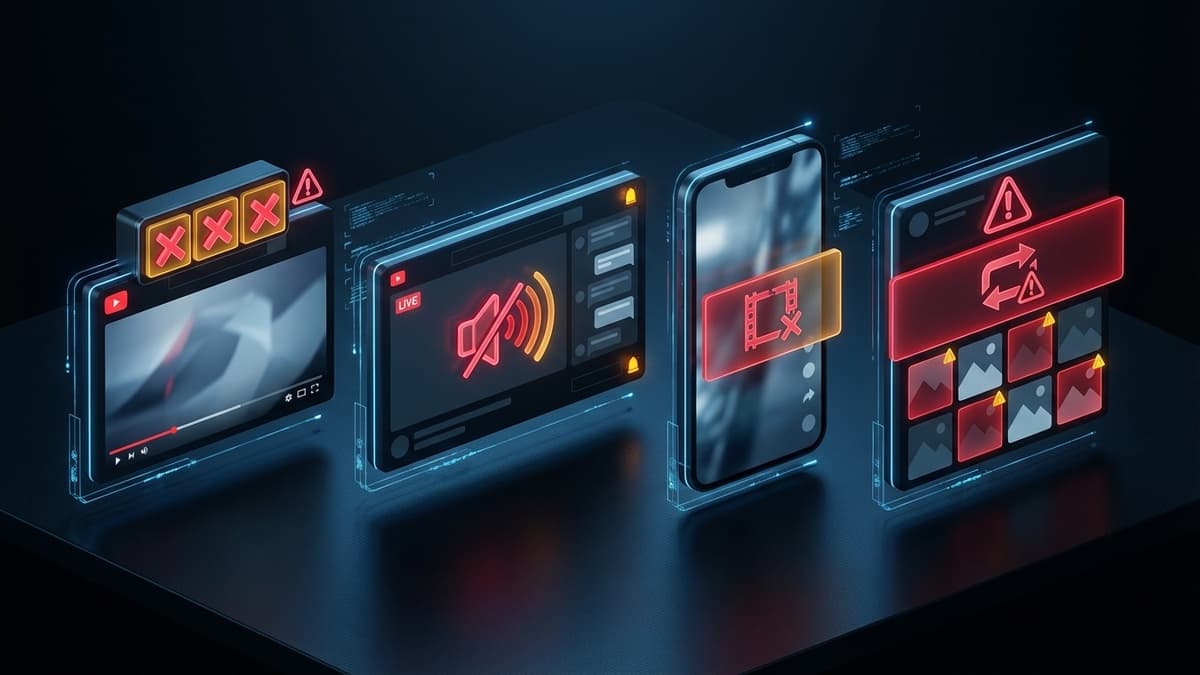
YouTube is where most of the confusion originates, because YouTube has three separate copyright enforcement mechanisms running simultaneously. Understanding all three clears up most of the misunderstanding.
Layer 1: DMCA takedowns (manual complaints)
Any copyright owner can file a DMCA takedown through YouTube's Copyright Complaint form. If YouTube determines the notice is valid, the video is removed and the uploader receives a copyright strike. YouTube operates a three-strike system on a rolling 90-day window:
- First strike:The video is removed. The uploader must complete YouTube's Copyright School. They cannot upload, livestream, or post community content for 1 week. The strike stays on the channel's record for 90 days.
- Second strike (within 90 days): The video is removed. The uploader cannot upload, livestream, or post for 2 weeks.
- Third strike (within 90 days): The channel is permanently terminated and all videos are removed.
Each strike expires after 90 days, resetting the count. But a third strike within that window is terminal — there is no fourth chance.
Layer 2: Content ID (automated matching)
This is the system most people confuse with copyright strikes, and it's completely separate. We'll cover it in the next section.
Layer 3: Platform-level manual review
YouTube's Trust & Safety team can also remove content that violates Community Guidelines (including copyright-adjacent issues), independent of the DMCA process. These aren't copyright strikes — they're Community Guidelines strikes, which have their own separate penalty system.
Content ID: The Third Thing Nobody Explains
YouTube's Content ID system is the single biggest source of confusion in this entire topic. It launched in 2007, reportedly cost Google over $100 million to develop by 2018, and by 2021 was processing nearly 1.5 billion claims per year. By 2016, Google had already paid over $2 billion to rights holders through Content ID monetization. It's a massive system — and it's completely separate from DMCA takedowns.
Here's how it works: approved rights holders upload reference files (audio, video) to Content ID's database. When a new video is uploaded to YouTube, Content ID scans it against that reference database using digital fingerprinting. Google claims a 98%+ detection rate for matching. If a match is found, the rights holder has three options:
- Block — the video is made unavailable
- Monetize — the video stays up, but ad revenue goes to the rights holder (or is split)
- Track — the video stays up, the rights holder gets analytics on viewership
A Content ID claim is not a copyright strike. This is the single most misunderstood fact in YouTube copyright. Content ID claims do not count toward the three-strike system. They do not restrict your ability to upload. They do not put your channel at risk of termination. A Content ID claim and a copyright strike are two completely different things with completely different consequences.
Content ID is also not available to everyone. Only approved rights holders — typically large publishers, music labels, studios, and major creators — can submit reference files. Individual course creators and smaller content creators generally cannot access Content ID directly. If your course is being pirated on YouTube, your enforcement tool is a DMCA takedown, not Content ID.
How Other Platforms Handle It
YouTube gets the most attention, but every major platform has its own version of this system. Here's how the others work:
Twitch
Twitch uses a three-strike systemwhere the third strike results in permanent account termination. Unlike YouTube, Twitch does not disclose specific per-strike penalties (like upload restrictions) between the first and third strike. Twitch's automated audio muting for streams that detect copyrighted music does not count as a copyright strike — similar to how Content ID claims on YouTube operate outside the strike system.
TikTok
TikTok also operates a three-strike system with strikes expiring after 90 days — structurally similar to YouTube. A third strike within that window results in a permanent ban of the account.
Instagram / Meta
Instagram and Facebook operate under Meta's broader "repeat infringer policy,"but unlike YouTube, Twitch, and TikTok, Meta does not publicly disclose a specific strike count or threshold. There is no public "three strikes and you're out" rule — Meta reserves discretion over when to disable accounts for repeated infringement.
The universal constant
Regardless of the platform's internal strike system, the DMCA takedown process works the same everywhere. You send a valid notice with the six required elements. The platform removes the content. What the platform then does to the infringer's account — whether it's a formal strike, an informal warning, or nothing visible — varies entirely by platform.
Which One Matters More for Protecting Your Content?
If you're a content creator trying to protect your work, the DMCA takedown is the tool that matters. It's the mechanism you control. You file the notice. The platform removes the content. That's the direct outcome you care about.
Copyright strikes are a secondary benefit. They penalize repeat infringers and — if the system works as designed — eventually remove the worst offenders from the platform entirely. But you don't control whether a platform issues a strike, how many strikes the infringer already has, or whether the strike leads to meaningful consequences. That's the platform's business.
There's also the scope issue. A copyright strike only affects the infringer on one platform. A pirate who gets three strikes on YouTube loses their YouTube channel — and can immediately start distributing your content on Telegram, Discord, torrentsites, and file hosts where strike systems don't exist. The DMCA takedown, by contrast, works everywhere. You can file with any platform, any search engine, any hosting provider that operates under US law.
For course creators and online educators, the most common piracy channels — Telegram groups, torrent sites, file hosts — don't even have strike systems. Your only enforcement tool is the DMCA takedown itself. Understanding this distinction is the difference between a real enforcement strategy and hoping that YouTube's internal penalty system will solve your problem.
Key Takeaways
- A DMCA takedown is a legal mechanism under federal law (Section 512 of 17 U.S.C.) that works on any platform. A copyright strike is a platform-specific penalty defined by Terms of Service.
- The DMCA takedown is the cause; the copyright strike is often the effect. You file the takedown. The platform issues the strike.
- YouTube's Content ID claims are not copyright strikes. They operate in a completely separate system with different consequences. Don't confuse them.
- YouTube uses a three-strike system on a 90-day rolling window. Twitch and TikTok also use three strikes. Instagram/Meta does not disclose a specific threshold.
- Most piracy happens on platforms without strike systems — Telegram, Discord, torrent sites, file hosts. The DMCA takedown is the only enforcement mechanism that works across all of them.
- If you're protecting your content, focus on the tool you control: the DMCA takedown. Copyright strikes are a bonus, not a strategy.