Someone Is Selling My Course — How to Shut Them Down
You just found your course for sale on a site you've never heard of. Don't fire off an angry email. Work this playbook instead: lock down evidence, hit the right takedown channel for the venue, and cut off the reseller's traffic and revenue.

Maybe a student tipped you off. Maybe you searched your own course title and found it — your curriculum, your sales copy, sometimes your actual videos — listed for sale on a site you've never heard of, at a fraction of your price. When someone is selling your course, they're charging money for your work — and every sale they make is a sale you don't.
The instinct is to fire off a furious email to the seller. Resist it. Resellers who get spooked don't stop — they delete the listing, rotate to a new domain or username, and reappear somewhere you haven't found yet. What actually works is a sequence: evidence first, then the right takedown channel for the specific venue, then escalation if they dig in. This post walks through that sequence for course creators, online educators, and premium content creators — the same playbook applies whether the stolen product is a Kajabi course or a Patreon library.
One scoping note: this article is about resale — someone charging money for your content. If your problem is free sharing (Telegram links, torrents, file-host dumps), start with our companion action plan, my course is being pirated. The two overlap, but resale opens up pressure points that free sharing doesn't.
Step 1: Confirm It's Yours and Capture Evidence
Before you file anything or contact anyone, do two things: verify the listing actually contains your content, and preserve proof of the infringement. Everything downstream depends on this step.
Verification matters more than it sounds. Some "resellers" are pure storefront scams — the classic course reseller scam: they copy your course title, thumbnail, and sales copy but don't possess your files at all, and simply take buyers' money without delivering anything. The copied thumbnail and sales copy are still copyright infringement (a title by itself isn't copyright-protected — though it may raise trademark issues), and the fake listing is fraud against buyers — but it changes what you claim in a notice. A DMCA notice includes a sworn statement, and knowingly misrepresenting that material is infringing can make you liable for damages — so you want to be right about what's actually being copied. And to be clear on scope: what follows is practical guidance from enforcement work, not legal advice — if you're considering a lawsuit or damages, talk to an intellectual property attorney.
Then lock down the evidence, in this order:
- Exact URLs of every listing page, checkout page, and preview page you can find — not just the homepage.
- Full-page screenshotswith the URL bar and date visible. Capture the price, the seller's username, and any contact details they display.
- Archive copies — save each URL to the Wayback Machine or a similar archiving service. If the seller deletes the listing tomorrow, you still have a third-party timestamped record.
- A dated log — a simple document noting when you discovered each URL and what it contained. Takedowns sometimes turn into disputes, and contemporaneous notes are worth a lot.
What about buying a copy to confirm they really have your files? Some creators do a test purchase, and it does produce the strongest possible evidence. But weigh it: you're handing your payment details to someone already comfortable with theft, and you're putting a few dollars in their pocket. If you go this route, use a virtual card, and screenshot the entire checkout and delivery flow. In most cases, though, the copied preview content and sales assets visible on the listing are already enough to support a takedown, with a duplicated curriculum outline as corroborating evidence of copying.
Do not message the seller, comment on the listing, or post about it publicly before your evidence is captured. Listings vanish the moment a seller senses attention — and a deleted listing with no archive copy is much harder to act on.
Step 2: Identify the Venue — It Decides Your Takedown Path
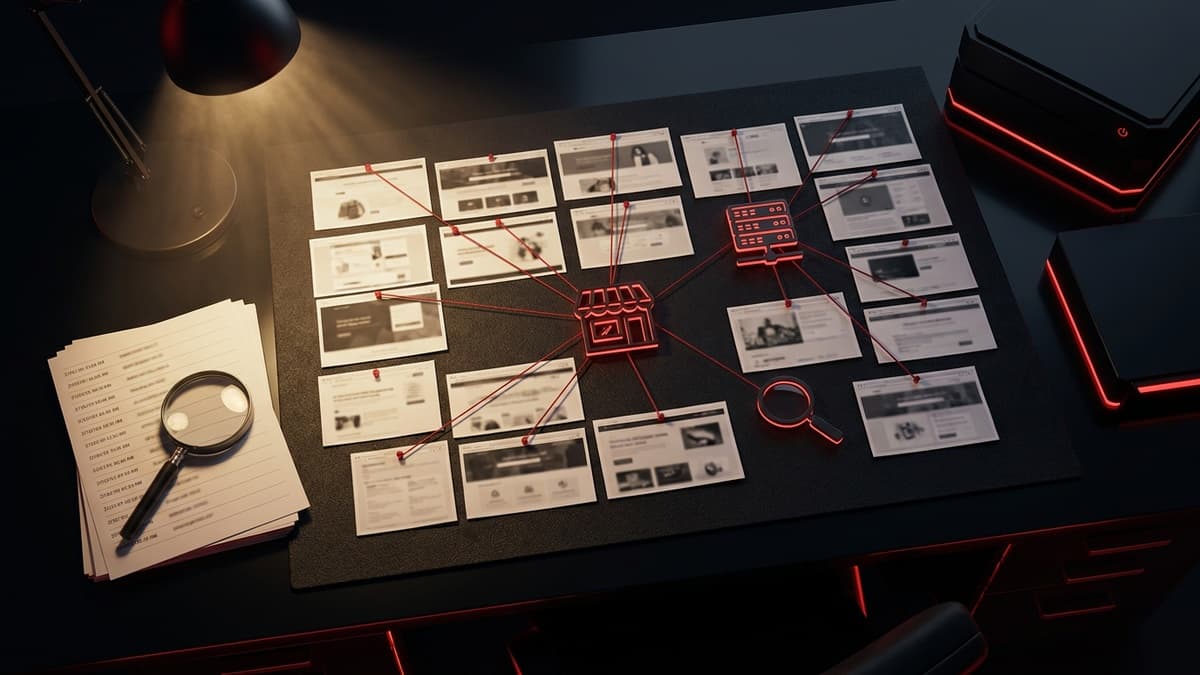
Here's the part most creators get wrong: you almost never go after the seller directly. You go to the layer above them — the marketplace hosting their listing, the company hosting their website, the messaging platform hosting their channel, or the search engine sending them buyers. Each venue has a different door to knock on.
A marketplace or platform listing
If your course is listed on a marketplace or storefront platform — an auction site, a digital-goods marketplace, a course platform, a general e-commerce site — use that platform's IP-infringement or copyright report form. Established platforms maintain these because processing valid notices is how they keep their legal safe harbor, so a complete, well-documented report is likely to get actioned. Include your evidence, your original sales page as proof of ownership, and the exact listing URLs. If you haven't written a takedown notice before, our guide on how to file a DMCA takedown covers every required element and common rejection reasons.
A standalone clone site
Clone sites — standalone websites built to sell stolen courses, often mimicking the look of legitimate course platforms — won't respond to a notice sent to their own contact form. Go over their head to the hosting provider:
- Run a WHOIS lookupon the domain and check the site's IP address to identify who hosts it. Registrant details are often privacy-redacted, but the hosting provider usually isn't hidden.
- Send your DMCA notice to the host's designated DMCA agent or abuse contact— typically listed in their terms of service, the U.S. Copyright Office's DMCA agent directory, or at an
abuse@address. - If the site sits behind Cloudflare, file through Cloudflare's abuse report form — Cloudflare isn't the host, but its process routes copyright complaints toward the actual origin provider.
A Telegram channel or Discord server
A growing share of course resale happens inside messaging apps — channels selling "course bundles" for a few dollars. Both platforms accept copyright complaints: Telegram processes reports against infringing public channels and groups, and Discord has its own copyright reporting path for servers. Expect churn: sellers reopen under new names, so this venue rewards persistence and monitoring more than any other.
Search engines — when the host won't act
Some hosts — particularly offshore ones that market themselves as "DMCA-ignored" — simply won't respond. That doesn't mean you're stuck. Google, Bing, and Yandex each accept copyright removal requests against individual URLs — and because DuckDuckGo sources its traditional results from Bing, a Bing removal clears it there too. Scrubbing a reseller from all four cuts off a large share of their buyer traffic even while the site itself stays online. A storefront nobody can find makes very few sales. This is the core of our search engine delisting service — and in our enforcement work, sellers delisted from Google often still rank on Yandex and DuckDuckGo, which most creators never think to check.
Step 3: If They're Charging, Report the Payment Trail
Because the seller is charging money, there's one more pressure point free-sharing pirates don't expose: the checkout. If the reseller takes payment through a mainstream processor, that processor has an acceptable use policy that prohibits selling infringing goods — and processors do review well-documented abuse reports.
A useful payment report looks a lot like a takedown notice: identify yourself as the copyright owner, link your original sales page, list the exact URLs where the infringing sale happens, and attach the checkout evidence you captured in step one. Vague complaints ("this seller is a scammer") go nowhere; documented infringement reports tied to a specific merchant get looked at.
Keep this lever in perspective, though. It's supporting pressure, not the headline move. Many resellers deliberately use cryptocurrency or obscure regional processors precisely to stay out of reach, and even a successful payment report doesn't remove the listing — buyers can still find it, and the seller can swap in a new checkout. In our own enforcement work we also report operations to payment processors where applicable, but always alongside takedowns against the listing, the host, and the search results — never instead of them.
Lone Reseller or Clone Network? It Changes the Play
Before you commit hours to this, figure out which kind of operation you're facing — because the right amount of effort differs by an order of magnitude.
A lone resellerlooks like this: one listing, or one small storefront, often a personal account on a marketplace or a single Telegram channel. Your course might be one of a handful they sell. Here, a single well-aimed takedown — the platform's IP form, or one notice to their host — usually ends it. Casual resellers rarely fight back; the margin isn't worth the friction.
An industrial clone network looks very different. The tells:
- Your course is one of thousands listed, at prices that make no economic sense for a legitimate seller.
- The site's design is templated— search a distinctive phrase from its footer and you'll often find the same template on several other domains.
- The domain was registered recently, behind a privacy service, often at a registrar known for tolerating abuse.
- Taking down one URL changes nothing, because a mirror domain already carries the same catalog.
Against a network, per-URL takedowns are whack-a-mole. The strategy shifts to host-level complaints covering the whole domain, search-engine delisting at scale, and continuous monitoring for the mirrors you haven't found yet. Many of the biggest offenders targeting course creators are documented in our Udemy clone sites list — worth checking whether your reseller is part of a known network before you plan your response.
A lone reseller is an incident. A clone network is weather. You resolve the first; you build systems for the second.
Prevention: Monitoring, Watermarks, and Realistic Expectations
You cannot make a course un-stealable — anything a paying student can watch, a determined pirate can copy. What you can do is make theft fast to detect and easy to trace, which is what actually shortens the window in which a reseller earns money from your work.
- Set up standing searches.Alerts on your course title and your name combined with terms like "free", "download", or "discount" — and periodic manual sweeps of Telegram search, Google, Bing, Yandex, and DuckDuckGo.
- Watermark per buyer where practical.A visible overlay with the purchaser's name or email, or a unique identifier embedded per purchase, means a leaked copy traces back to a specific buyer. That deters casual leakers and tells you exactly which access to revoke.
- Keep ownership proof easy to produce. Keep your original sales page live, and keep dated masters or raw project files. Takedown disputes are much easier to win when you can prove you created it first.
- Set expectations honestly.Watermarks can be cropped or stripped by someone determined, and no monitoring catches everything on day one. The goal isn't perfect prevention — it's cutting detection time from months to days, so takedowns land while the reseller's listing is still new.
When to Hand It to a Professional
Handle it yourself when it's one listing on one platform — the steps above will genuinely get you there. Hand it off when the problem is bigger than your available hours: multiple venues at once, a clone network with rotating mirrors, hosts that ignore you, or re-uploads appearing faster than you can file.
The honest math is about your time, not just the takedowns. Every hour spent running WHOIS lookups, drafting notices, and chasing non-responsive abuse desks is an hour not spent making the next course, serving your students and subscribers, or marketing to the people who actually pay you. For a single incident that trade is fine. For an ongoing campaign against your catalog, it quietly becomes a part-time job you never applied for.
What to look for in a service, whoever you choose: coverage depth — enforcement across Google, Bing, Yandex, DuckDuckGo, Telegram, Discord, torrents, and file hosts, not just a Google form on autopilot; human follow-through — investigators who escalate to hosts and re-file when something reappears, rather than fire-and-forget automation; and transparent pricingyou can compare against the hours you're currently losing — at rates that undercut the big monitoring platforms. That combination is exactly what our course piracy protection service is built around — and the first assessment of where your course is being resold is free.
Key Takeaways
- Evidence before contact — capture URLs, screenshots, and archive copies before the seller knows you've noticed.
- The venue decides the takedown path: marketplace IP forms, host DMCA agents for clone sites, platform copyright reports for Telegram and Discord.
- When a host ignores you, search engine delisting cuts off the reseller's buyer traffic anyway.
- Payment-processor reports are useful supporting pressure when a seller charges through mainstream checkouts — one lever among several, not the whole plan.
- A lone reseller usually folds after one well-aimed takedown; a clone network requires host-level action, delisting at scale, and ongoing monitoring.
- Prevention is really detection: standing searches and per-buyer watermarks shrink the window a reseller gets to profit from your work.