Udemy Course Leaked? Why It Happens and What Instructors Can Do
Your Udemy course is on a 'free course' site, a Telegram channel, or a torrent index — and Udemy's own enforcement won't cover most of it. Here's why leaks happen, whose job the cleanup actually is, and the enforcement plan that works.

It usually starts with a Google search of your own course title — or a student casually mentioning they "found it cheaper." And there it is: your Udemy course, the one that took months to record, sitting on a "free courses" site or pinned in a Telegram channel with thousands of members.
The first instinct is to report it to Udemy and wait. That's where most instructors lose weeks, because Udemy's own enforcement is strongest on udemy.com. Off-platform, Udemy offers a limited anti-piracy program — proactive monitoring only for its most-purchased Udemy-exclusive courses, plus a reactive piracy-report form for everyone else, focused mainly on search delisting. It has no obligation to chase your leak, and many platforms only act on claims from the copyright owner. The copyright in your course content belongs to you— which means external enforcement effectively falls to you. The good news: as the copyright owner, you have real tools — DMCA notices to hosts, search-engine delisting, and Telegram's own copyright reporting channel — and they work far more often than the doom-posting suggests.
This deep dive covers how Udemy courses actually leak, where the copies end up, the responsibility split most instructors misunderstand, and a step-by-step action plan — including an honest section on what's genuinely not worth your time. And while it's written for Udemy instructors, the same playbook applies to anyone selling their work behind a paywall — coaches, community owners, and premium content creators included.
Why Udemy Courses Leak
Udemy courses leak because video that a paying student can watch is video that a determined pirate can capture. There is no technical protection — on Udemy or anywhere else — that fully survives contact with a screen recorder. In practice, leaks come from four main paths:
- Bulk downloader tools.There's a category of scripts and browser tooling built specifically to rip every lecture from courses an account is enrolled in — video, resources, captions, the lot. One enrollment during a deep-discount sale is enough to extract a clean copy of your entire course.
- Screen recording.The low-tech fallback that never goes away. Even where a platform applies technical protections to its player, the output of a screen can always be re-recorded. Quality drops slightly; the piracy value doesn't.
- Buyers who redistribute.Someone pays for your course during a sale, downloads or records it, and uploads it to a Telegram channel or file host — sometimes for clout, sometimes for a paid "premium" channel subscription they run.
- Coupon-abuse resellers.Promotional 100%-off coupons are harvested and republished by coupon-aggregator sites within hours of you issuing them. Some of that traffic is legitimate bargain hunters — but resellers also use free enrollments as a zero-cost way to rip content, and some resell "lifetime access" to material they never had rights to.
Notice what's noton the list: hacking. Nobody needs to break into Udemy to pirate your course. Every one of these paths flows through ordinary, legitimate-looking access — which is exactly why platform-side prevention can only ever slow leaks down, never stop them. The realistic goal isn't a leak-proof course; it's making pirated copies hard to find and short-lived when they surface.
Where Leaked Udemy Courses End Up
Leaked Udemy courses concentrate in four places: Telegram channels, "free course" clone sites, torrent indexes, and file hosts. Each behaves differently, and each needs a different takedown approach.
- Telegram channels and groups.In the takedown work we run, Telegram is the most active distribution channel for pirated courses we see. Channels share direct download links or forward entire course folders, and large ones operate completely in the open. We've written a full breakdown of how this ecosystem works in our guide to Telegram piracy. Telegram does accept copyright complaints — but channels often resurface under new names, so this is a monitoring game, not a one-shot takedown.
- "Free course" clone sites.Sites that scrape Udemy listings wholesale — your title, description, promo video, sometimes the full course — and wrap them in ads or "free download" buttons. Some host content directly; many just funnel visitors to file hosts. These sites are the main reason instructors find pirated results ranking for their own course name. We maintain a running list of known Udemy clone sites so you can check the usual suspects quickly.
- Torrent indexes.Popular courses get bundled into torrents, often packaged with dozens of others. The files themselves live on a decentralized swarm you can't take down directly — but the listing pages and the search results pointing to them absolutely can be removed.
- File hosts. The storage layer underneath most of the above — cyberlocker services and abused cloud-drive links. Telegram posts and clone sites frequently point to the same file-host upload, which means one well-aimed DMCA notice to the host can kill links across several front-ends at once.
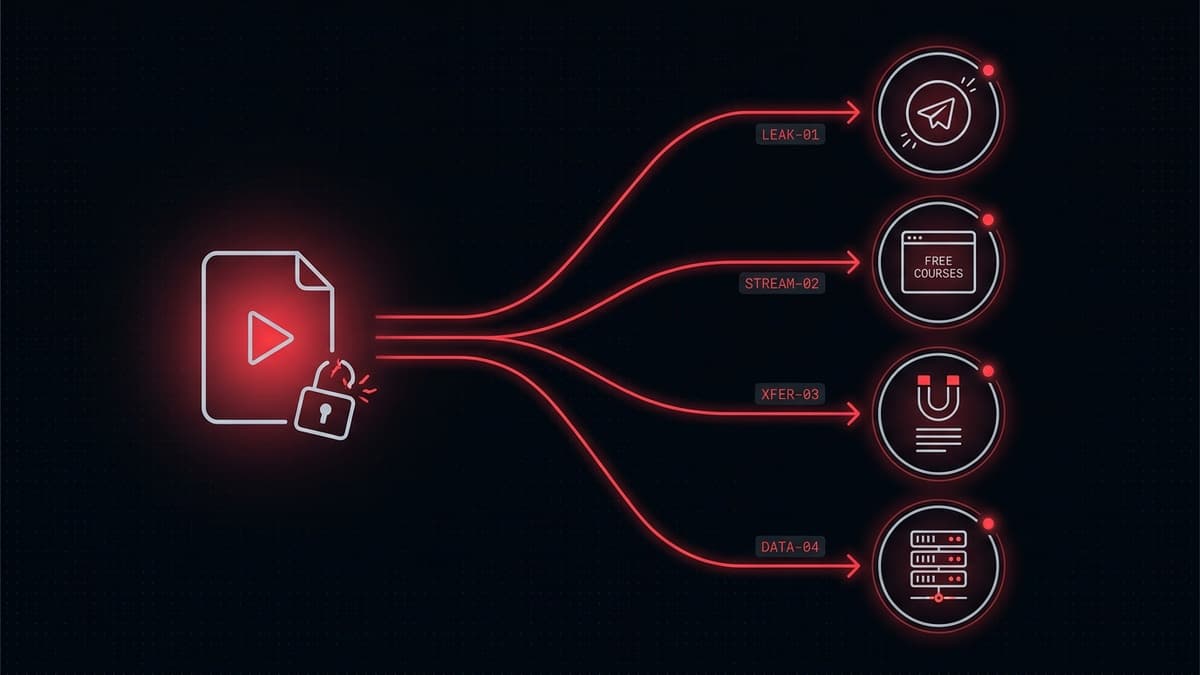
A single leak typically lives on all four layers at once: a clone site ranks for your course name, links to a file host, and gets amplified through Telegram — while a torrent copy circulates separately. Effective enforcement hits each layer, because removing one leaves the others quietly feeding new visitors.
Whose Job Is Enforcement — Udemy's or Yours?
Here's the split, and it's the most misunderstood part of this whole topic: Udemy enforces on Udemy; you enforce everywhere else.
If someone re-uploads your course to Udemyunder their own instructor account, that's squarely Udemy's problem — their intellectual property process exists for exactly this, and reporting it through their official channels is the right move. But if your Udemy course was copied to a clone site, a Telegram channel, or a torrent index, Udemy has no obligation to pursue it — its off-platform program is limited and prioritizes its top-selling exclusive courses, and many platforms will only act on a claim from the copyright owner. Waiting on Udemy is how leaks stay live for months.
The reason you can always act — without waiting for Udemy's limited program — comes from Udemy's own instructor terms: when you publish a course, you grant Udemy a license to host, market, and sell it, but ownership of the content stays with you. That ownership is precisely what gives you direct standing to send a DMCA notice to any outside host. It's not a consolation prize; it's the legal basis for everything in the next section.
Reframe the bad news: Udemy won't chase most external leaks for you — but you don't need its permission to act. You own the copyright. Every takedown mechanism that exists for rights holders is available to you, starting today.
For the platform-specific mechanics — including what Udemy's own process does and doesn't cover, and exactly where to send notices — see our Udemy DMCA takedown guide.
The Instructor Action Plan
The plan is: capture evidence, hit the host, cut the discovery paths, report the Telegram distribution, then put monitoring on a schedule. In that order — evidence first, always. (One note before the legal steps: this is practical guidance from running takedowns day in and day out, not legal advice. For high-stakes situations — large-scale commercial piracy, or anything heading toward litigation — talk to a copyright attorney.)
1. Capture evidence before anything else
Before you report anything, record it: the exact URL of every infringing page, full-page screenshots showing your content and the date, and the download links themselves. Takedowns sometimes trigger counter-notices or disputes — if one lands, the host may restore the material in 10–14 business days unless you escalate, as our counter-notice guide explains — and pirate pages have a habit of disappearing and reappearing. A dated evidence trail keeps you credible and saves you from re-finding everything later.
2. Send a DMCA notice to the host
For clone sites and file hosts, identify who actually hosts the content. A WHOIS or hosting lookup on the domain is the starting point — though many piracy domains sit behind privacy-redacted WHOIS and a CDN or reverse proxy, in which case the proxy's abuse-report process forwards your notice to the underlying host. Then send a properly formatted DMCA notice to the site's designated agent and the hosting provider's abuse contact. A valid notice needs the exact infringing URLs; identification of your original work (a link to your live Udemy course page works); your name and contact information; a statement of good-faith belief that the use is unauthorized; a statement, under penalty of perjury, that the notice is accurate and that you're the owner or authorized to act; and your physical or electronic signature (a typed full name works). The element-by-element walkthrough is in our guide to filing a DMCA takedown. Hosting providers act on valid notices far more reliably than the pirate sites themselves — and remember that killing one file-host upload often breaks links across multiple front-ends. In parallel, submit Udemy's own third-party piracy report form — it's free, and it routes external links to Udemy's anti-piracy vendor for whatever action its program covers.
3. Request search-engine delisting
Even when a rogue site ignores your notice, you can remove it from the place buyers actually find it: search results. File copyright removal requests with Google and Bing — and then do what most instructors and most services skip: file with Yandextoo (it has its own removal form, and its index doesn't mirror Google's), and cover DuckDuckGo— it has no public removal form, but its web results are largely sourced from Bing, so your Bing removal usually clears it; for stragglers, DuckDuckGo accepts DMCA notices by email to its legal contact. If a pirated copy can't be found, most of its damage is gone. This is the core of search-engine delisting as a discipline.
4. Report the Telegram channels
Telegram accepts copyright complaints against channels and posts distributing infringing content — report through its official copyright-reporting channel with the specific post links, not just the channel name. Expect slower, less predictable handling than a hosting provider, and expect popular channels to resurface under new names. That's not a reason to skip it; it's a reason to fold Telegram into your monitoring loop rather than treating it as done after one report.
5. Put monitoring on a cadence
A leak you find in week one is a nuisance; a leak you find in month six has been quietly redirecting buyers the whole time. A sustainable cadence for a solo instructor:
- Weekly or biweekly:search your exact course title in quotes plus "free download" on Google, Bing, and Yandex; search your course name and your instructor name inside Telegram.
- Passive layer:Google Alerts on your course title and brand combined with terms like "free" and "download".
- After every big promotion: do an extra sweep — deep-discount sales and coupon pushes are exactly when rip-and-share activity spikes.
If your course is popular enough that new copies appear faster than you can file, that's the point where dedicated course piracy protection stops being a luxury — continuous monitoring, filing, and follow-up by human investigators is a different kind of pressure than a creator squeezing takedowns into their evenings.
What NOT to Bother With
Four things aren't worth your time: DMing the pirates, DMCA-ing dead mirrors, chasing torrent seeders, and panic-rebuilding your course. Just as important as the plan is what to leave out of it — instructor anger is finite fuel, so spend it on actions that move the needle.
- Don't DM the pirates. Messaging the admin of a piracy channel or the operator of a clone site to ask them to stop almost never works — these are people whose entire operation is built on ignoring rights holders. At worst, you tip them off to mirror the content somewhere harder to reach. Skip the confrontation and go straight to the parties who respond to process: hosts, search engines, and platform abuse teams.
- Don't DMCA dead mirrors. Piracy ecosystems are full of stale listings — pages advertising a download whose file-host link died months ago. Click through before you file. A dead link is already doing zero damage, and every notice you write for one is time not spent on a live copy.
- Don't obsess over torrent seeders. You cannot DMCA a swarm — the files live on the machines of the people sharing them, and no takedown notice removes files from those machines. What you cando is remove the torrent listing pages and delist them from search, which starves the swarm of new downloaders. Chasing individual seeders is effort spent on the one layer of the stack you can't actually clean.
- Don't rebuild your course out of panic. Some instructors respond to a leak by re-recording everything or gutting their curriculum previews. A leak is a distribution problem, not a content problem — and the pirates will rip version two exactly the way they ripped version one.
The audience buying on piracy channels skews heavily toward people who were never going to pay you. That doesn't make piracy harmless — clone sites ranking for your course name intercept real buyers — but it does tell you where to aim: protect the discovery paths your actual students and subscribers use, and let the darkest corners of the swamp stay the swamp.
Key Takeaways
- Udemy courses leak through ordinary access — downloader tools, screen recording, redistributing buyers, and coupon-abuse resellers — so prevention alone can't win; fast detection and takedowns can.
- Leaked copies concentrate on four layers: Telegram, clone sites, torrents, and file hosts. Effective enforcement hits all of them.
- Udemy fully enforces only on udemy.com; its off-platform piracy program is limited and prioritized toward top Udemy-exclusive courses. You retain copyright under Udemy's instructor terms — external leaks are effectively yours to enforce, and that ownership is what empowers you to act.
- The working sequence: evidence capture → DMCA to the host → search-engine delisting across Google, Bing, and Yandex (Bing removals typically carry over to DuckDuckGo) → Telegram reporting → monitoring on a weekly-to-biweekly cadence.
- Skip the dead ends: DMs to pirates, notices for dead mirrors, and chasing torrent seeders. Aim at hosts, search engines, and platform abuse teams — the parties that actually respond.